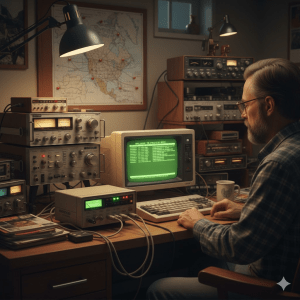
Packet Radio: The Internet Before the Internet, for Ham Operators
Before the ubiquitous reach of the internet, long before Wi-Fi and fiber optics, a dedicated group of amateur radio operators were already transmitting digital data across vast distances. They were using packet radio, a fascinating and still-relevant facet of ham radio that essentially created a localized, radio-based “internet” for enthusiasts.
What is Packet Radio?
At its core, packet radio is a method of transmitting digital data over amateur radio frequencies. Instead of sending continuous analog voice signals, data is broken down into small “packets,” each containing a portion of the message, along with header information like the sender’s callsign, the recipient’s callsign, and error-checking data. This approach is remarkably similar to how data travels across the internet today.
The Early Days: A Digital Frontier
Packet radio really took off in the 1980s and 90s, offering hams a groundbreaking way to communicate. Imagine a world where email was a novelty, and instant messaging was years away. Packet radio allowed operators to:
-
Send and receive messages (email-like): Operators could exchange text messages with each other, often storing them on local “bulletin board systems” (BBSs) that were accessible via radio.
-
Chat in real-time: Simple chat programs allowed for direct, text-based conversations between two or more stations.
-
Access remote data: Some packet systems offered weather data, news bulletins, and even early forms of file transfers.
-
Network with digipeaters: “Digital repeaters,” or digipeaters, automatically re-transmitted packets, extending the range of communication far beyond line-of-sight. This created extensive regional and even national networks.
How it Works: The TNC at the Heart
The key piece of equipment for packet radio is the Terminal Node Controller (TNC).
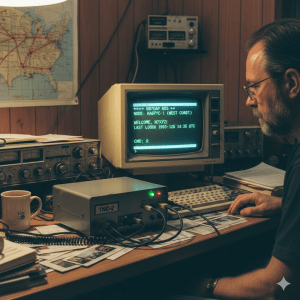
This device acts as an interface between a computer (or a terminal) and a radio transceiver. Its main functions include:
-
Modulation/Demodulation: Converting digital data from the computer into audio tones that the radio can transmit, and vice-versa.
-
Packet Assembly/Disassembly: Breaking outgoing data into packets and reassembling incoming packets into coherent messages.
-
Error Correction: Ensuring that data is received accurately, often by requesting re-transmission of corrupted packets.
-
Protocol Handling: Managing the AX.25 protocol, which is the standard for packet radio communication.
A typical packet radio setup involves:
-
A computer (often an older PC, but modern computers with sound card interfaces can also be used).
-
A TNC.
-
A VHF/UHF radio transceiver (though HF packet also exists).
-
An antenna.
Packet Radio Today: Beyond Nostalgia
While the internet has largely superseded packet radio for everyday communication, packet remains incredibly valuable for several reasons:
-
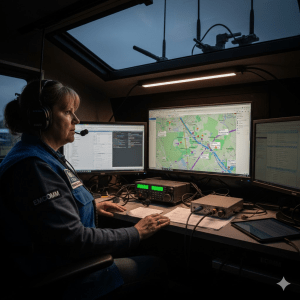
Emergency Communications (EmComm): In times of disaster when traditional communication infrastructure fails, packet radio provides a robust, independent means of sending vital information, such as damage reports, health and welfare messages, and resource requests. Many emergency operations centers (EOCs) have packet capabilities.
-
APRS (Automatic Packet Reporting System): This is perhaps the most visible and widely used application of packet radio today. APRS allows hams to transmit their real-time location, weather data, and short messages. This data can be viewed on online maps (like APRS.fi) and is invaluable for tracking mobile stations, particularly during events or emergencies.
-
Digipeater Networks: The underlying digipeater infrastructure still forms a critical backbone for APRS and can be repurposed for general packet messaging when needed.
-
Experimentation and Learning: For many hams, packet radio offers a hands-on opportunity to understand digital communication protocols, networking concepts, and radio interfacing. It’s a fantastic learning tool.
Getting Started with Packet Radio
For those interested in exploring packet radio, the entry points are more accessible than ever. Modern “software TNCs” use a computer’s sound card to perform the modulation and demodulation, eliminating the need for a dedicated hardware TNC. This means you can get on the air with just a computer, a radio, and the right software.
Packet radio stands as a testament to the innovative spirit of amateur radio. It was a pioneering effort in digital communication, laying groundwork that, in some ways, foreshadowed the internet itself. For emergency preparedness, real-time tracking, and pure technical enjoyment, packet radio continues to be a vibrant and important part of the ham radio world.
Leave a Reply